
National: Breaking Barriers: How Muslim Students Are Redefining Success in Indian Education.

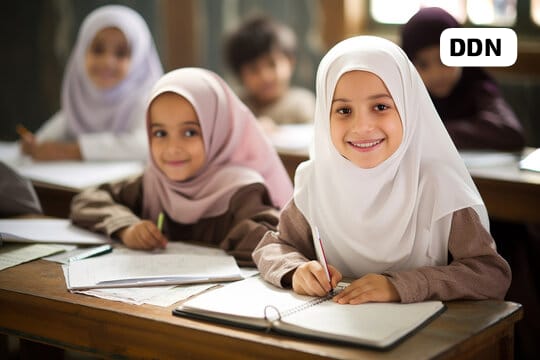
Muslim students in India are reshaping the narrative of academic achievement, especially in professional fields, by breaking down barriers and raising standards in academics and competitive exams. Exceptional students are emerging from both rural madrassa backgrounds and metropolitan coaching centers, transcending long-held stereotypes. Their success stems from deep personal commitment, strong community support, and a determination to challenge societal preconceptions.
The recent NEET UG results offer a compelling example. Musa Kaleem, a Muslim student from Guwahati, scored an impressive 99.97 percentile- the highest score in Assam among over 42,000 applicants. In 2024, more than 2.08 million students appeared for NEET, with around 1.15 million qualifying. This reflects how students from all backgrounds, including many Muslims, are competing at the highest level. Amina Arif Kadiwala, an Urdu-medium student from an underprivileged family in Mumbai, also secured a strong score in NEET UG 2024. Her achievement inspired many and served as a powerful reminder that neither language nor social status is a barrier to success. These success stories are not incidental-they are rooted in consistent hard work and community encouragement. Musa from Assam attributes his performance to a disciplined routine, coaching, and unwavering family support. Mubashira Anjum, a Muslim girl from Nagpur, succeeded in her Class 12 exams while attending both a madrassa and a regular school. Her achievement illustrates how cooperation between families, students, and community institutions can help overcome obstacles such as language barriers. The stories of success are as diverse as they are inspiring. Areeba Umar Hangora and Momin Muaz excelled in Maharashtra’s HSC exams, proving that religious education and academic excellence can coexist. Their stories challenge the assumption that faith and modern education are incompatible. Pioneers like Maryam Afifa Ansari-India’s first female Muslim neurosurgeon-exemplify the emergence of Muslim women who are forging bold paths in elite professions. Research by Yugul Kishore Mishra, Principal of Saraswati Vidya Mandir, UP revealed a significant 30% increase in Muslim enrolments over three years, underscoring a broader trend of engagement and aspiration.
There is growing evidence that Indian institutions are supporting these ambitious students. Government schemes, scholarships, and reservation policies have been structured to benefit minority and underprivileged communities. Between 2016 and 2021, Central Government initiatives awarded over 2.3 crore scholarships to Muslim students, amounting to approximately 9,904 crores. These efforts reflect an expanding financial safety net. Despite underrepresentation in higher education-Muslims make up only 4.6% of enrolled students, much lower than OBC and SC percentages the growing number of high achievers indicates change is underway. These examples redefine success through perseverance, resourcefulness, and defiance of stereotypes.
Collaborative efforts among the Government, NGOs, and faith-based organizations are improving access to education and nurturing ambition. The rise of Muslim achievers reflects a transformation in the narrative surrounding India’s minority communities. Students today are defying expectations with determination and support, overcoming barriers of language, religion, and economics. In regions like Northeast India, achievers such as Musa Kaleem have become local icons, inspiring schools and policymakers to build more inclusive learning environments.
While disparities persist for instance, Muslims made up only 2.9% of successful UPSC candidates in 2022-the increasing number of toppers in NEET and board exams suggests that foundational progress is being made. The implementation of consistent coaching and scholarship initiatives indicates a promising trajectory. India stands at a pivotal moment where empowering students from all backgrounds is crucial to realizing its full potential.
The stories of Amina, Musa, Mubashira, and many others should not be seen as isolated victories. They mark the rise of a new educational ecosystem driven by mentorship, financial assistance, collective belief, and relentless ambition. Muslim students are not only redefining academic success in India-they are reimagining what it means to belong in a pluralist, meritocratic society. Their journeys prove that excellence can emerge from any corner when opportunity meets determination. These students show us that the future of a diverse and democratic India lies in unlocking the potential of every child, regardless of background.